
General Contracting Services
General Contracting
Las Cruces, NM
Las Cruces, NM
Commercial Concrete Floors in Las Cruces and Dona Ana County
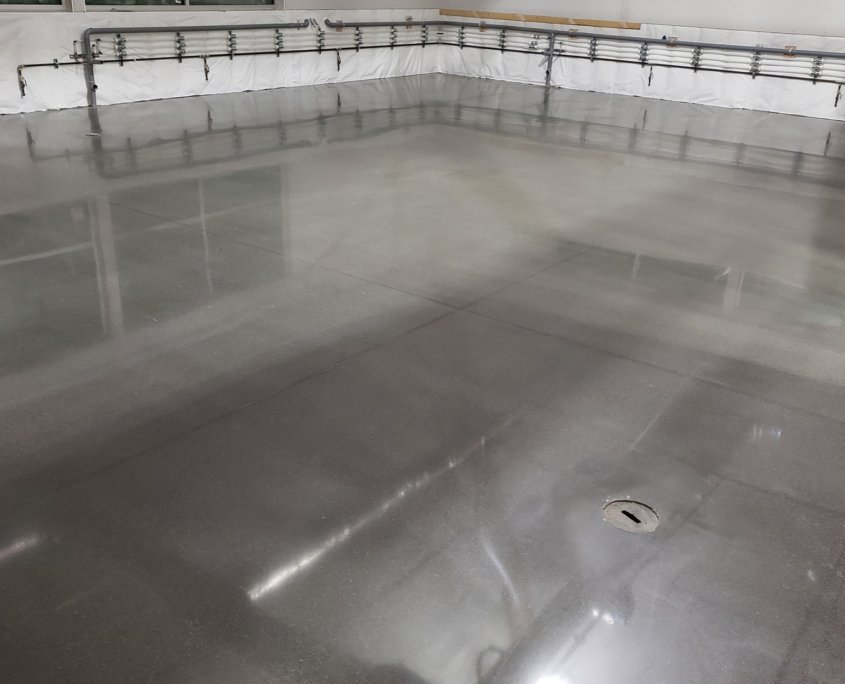
A warehouse floor gets judged every day by the forklift that crosses it, and the verdict comes in years, not weeks. Commercial concrete floors cover slabs on grade, suspended and topped slabs, and the specialized industrial floors that carry racking, wheeled traffic, wash-down or process loads. Flatness, levelness, joint layout, curling and surface hardness are all decisions that get made before the first truck shows up.
We place and finish slabs for warehouses, distribution buildings, retail shells, medical offices, food plants and light industrial space across Las Cruces and Dona Ana County. The work includes subgrade preparation, vapor barrier, reinforcing or fibers, joint layout, placement, finishing, curing, saw cutting and joint filling, along with the details that pass through the slab, like underslab plumbing, conduit and floor drains.
A good slab in the Mesilla Valley starts with respect for the desert. Dry air, hot afternoons and wind can pull moisture out of fresh concrete faster than a crew can finish it. We plan for that, and we explain the plan to owners so nobody is surprised by cut lines, color variation or early shrinkage.
How We Place a Floor
It starts at the table with the structural engineer, the flooring contractor, the racking supplier and the owner. What loads are coming? Where will the rack legs sit? Will narrow-aisle equipment need tight flatness numbers? Are there coatings, polished finishes or wash-down areas? Answers to those questions set the slab thickness, the reinforcement, the joint pattern and the finishing method. Then we prepare the subgrade, proof-roll it, check thickness, place the base course and lay out the vapor retarder, sealing every seam and penetration.
On pour day we use laser-guided screeding, bull floats and power trowels, and we time each pass to the way the concrete is setting, which varies hour by hour in the desert. Joints are cut early enough to control cracking, curing begins right away, and when flatness readings are specified we take them and share the results. The point is a floor that works for the person driving a lift truck on it, not just a floor that looks smooth from the doorway.
Floors by Building Type
A distribution center wants a slab built for racking, wide aisles and constant truck traffic. The Union Pacific Santa Teresa intermodal terminal lists 1,266 container and trailer parking stalls, expandable to 4,380, which gives a sense of the freight moving through the region and the buildings that serve it. Communities along I-10 such as Vado sit within easy reach of that corridor, and slabs for distribution and light industrial users there need to handle repeated wheel loads without joint failures.
A food and beverage processing floor is a different animal, with sloped drains, sealed joints, chemical resistance and cleaning regimes that would destroy a plain broom finish. Hatch is known worldwide for raising chiles, and NM 28 runs past farmland, dairy farms, vineyards and pecan orchards in the Mesilla Valley, so agricultural processing is a realistic part of the local market. We detail those floors with the food-safety consultant and the coating installer from the start.
Dry Air, Wind and Moisture
Las Cruces averages 9.14 inches of precipitation a year, and spring afternoons can be windy with blowing dust. Dry, windy days dry out the surface of a fresh slab before the body of the concrete has set, which is exactly how plastic shrinkage cracks start. We schedule pours for the cooler hours, use evaporation retarder, fog nozzles and windbreaks when needed, and keep finishers close behind the screed so the surface is never left alone.
Moisture can also come from below or from the mix itself, even in a dry climate, and floor coverings and coatings fail when installed over a slab that is still releasing it. We test slab moisture before coverings go down and hold the installer to the manufacturer's limits. We also coordinate dust control and cleaning, since blowing dust before a coating is applied can ruin the bond.
Safety on Slab Day
Slab work puts a lot of people, trucks and equipment in a small area. We hold a pre-pour meeting to walk through truck routes, pump placement, hand signals and who goes where, and we keep unauthorized visitors out of the zone. Wet cement is caustic, so kneepads, gloves and boots are standard, and we make sure crews have water and shade through the hot months.
Saw cutting and grinding create silica dust, so we use wet cutting or vacuum systems and keep respirator protection in place where required. Pump booms stay clear of overhead lines, and no one stands under a boom in motion. A safe slab day is usually a quiet one, and that is the kind we like.
Pour Sequence and Curing Time
Floor timing depends on the building. For a steel building, the slab often follows dry-in so the interior is protected. For tilt-up, the slab serves as the casting bed and has to be poured early and protected from panel damage. Outside the building, the pavement and aprons that connect to the floor are part of the same plan, which is why we coordinate with truck courts and dock aprons so the slab edges, dock levelers and exterior paving meet at the right heights.
Racking installers and flooring crews need to wait until the slab reaches the strength and moisture level the specifications call for, and we give them honest dates. Insulated and refrigerated buildings add under-slab heat and vapor details, which we cover under cold storage construction. For property management firms taking over a finished building, we leave a simple maintenance record covering joint filler, cleaning and what to avoid in the first weeks.
Plan your floor with us
Tell us how the floor will be used, from the lift trucks to the cleaning method, and we will build the slab around that. Send over the structural set and we will come back with a joint layout and a price.
Questions Owners Ask
What flatness can I realistically expect from a warehouse slab?
It depends on the specification, the placement method and the finishing sequence. If your equipment needs tight flatness and levelness numbers, tell us during preconstruction so we can specify laser screeding, set pour widths accordingly and plan for readings. We would rather agree on a target than argue about one later.
Will my slab crack?
Concrete will crack somewhere, and the goal is to control where. Proper joint spacing, early saw cutting, good curing and a well-prepared subgrade keep cracks on the joints and out of the middle of the aisle. We explain the joint layout to owners so a hairline at a control joint does not cause alarm.
How do hot, dry days affect scheduling?
They move pours earlier in the day and sometimes to the next morning. We use evaporation control and curing methods suited to the weather, and we avoid starting a large placement when the afternoon winds are likely to arrive before the crew has finished.
Do I need a vapor barrier in a dry climate?
Usually the design calls for one anyway, particularly under floor coverings or in conditioned buildings. Dry air does not guarantee a dry slab, and a vapor retarder protects finishes and indoor air quality. We follow the specification and flag it when a product change is proposed.
Can you pour a slab around existing equipment or racking?
Yes, with planning. In renovations we phase pours in bays, protect nearby operations and coordinate cutting and doweling into the existing slab. The key is a clear shutdown schedule so the owner knows which area is out of service and for how long.